

Introduction
With the developments of electronic devices from the era of industry up to the era of technology, they have evolved significantly, and everything has emerged from them to make our lives easier and simpler. Electronic devices are machines that have been developed to serve humans to make their environment and life easier in all fields. In this article, we will discuss several parts of them, from the smallest part to them. Even its final design, which is divided into different groups and many fields, and I will try hard to simplify the concept for the reader due to the large number of scientific names, which may be difficult to memorize or understand, but I will try to make you imagine the devices that we deal with every day in order to simplify them. Let us get to know them.
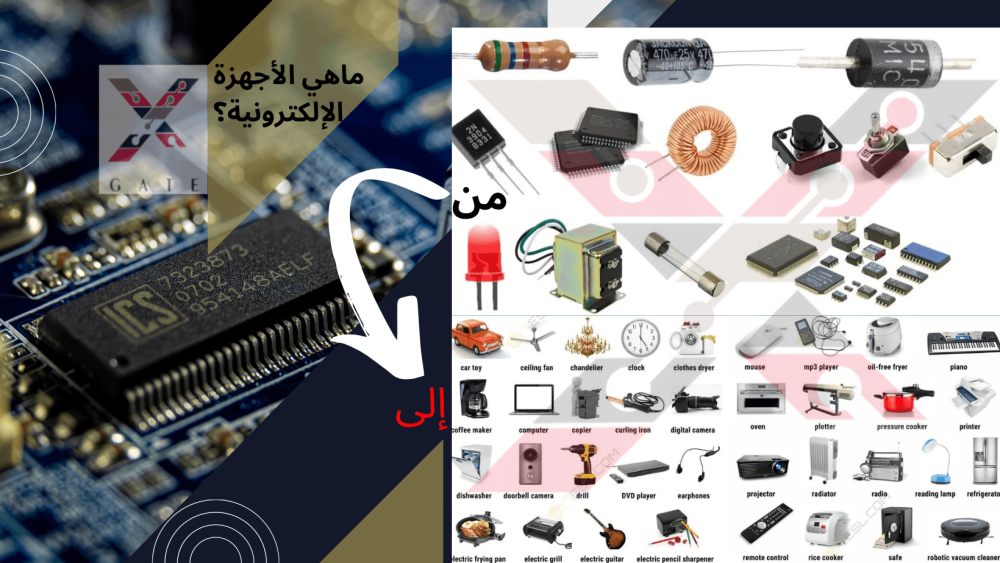
What are electronic devices?
Electronic devices are components that control the flow of electrical currents for the purpose of processing information and controlling a system. Notable examples include the transistor and the diode, a group called electronic components. Electronic devices are usually small and can be put together in packages called integrated circuits (IC). This miniaturization is fundamental to the modern electronics boom.
What is an integrated circuit?
An integrated circuit (also known as an IC, chip, or microchip) is an assembly of electronic circuits on a small flat piece of semiconducting material, usually silicon. In an integrated circuit, a large number of miniature transistors and other electronic components are integrated together on a chip. This results in circuits that are smaller, faster, and less expensive than those built from discrete components, allowing for a large number of transistors.
What are electronics?
Electronics is a subfield of electrical engineering that focuses on the use of active devices such as transistors, diodes, and integrated circuits to control and amplify the flow of electrical current.
And convert it from one form to another.
In other words, it is a scientific and engineering field that studies and applies the principles of physics to design, create, and operate devices that deal with electrons (electrons) and other electrically charged particles.
There are two types of electric charges (often carried by protons and electrons) and they are components of the atom.
Positive charge (proton)
Negative charge (electron)
Electric charges form an electric field, and if they are moving, they form a magnetic field. The combination of an electric field and a magnetic field is called an electromagnetic field and its interaction with charges is the source of the electromagnetic force, one of the four fundamental forces in physics. The study of charged particles and how their interactions are regulated by photons is called quantum electrodynamics.
Examples of electric current
Alternating current (AC) 110/220
Direct current (DC) 12/48v or analog to digital.
Electronics also includes the fields of microelectronics, nanoelectronics, optoelectronics, and quantum electronics, which deal with the fabrication and application of electronic devices on the microscopic, nanoscale, optical, and quantum scales.
We always hear about the components of corn, but we cannot imagine how we can work with them. Let me answer you in a simpler way. Nowadays, with the development of technology, all the tools are ready to make something, even if we are at home, but because we do not know enough about how to bring or take the components of corn, it will be difficult for us to know. Where can we buy it, for example, but in science it does not teach you how to make it, but rather teaches you how the atom works, which makes us not understand or know how to obtain it.
Let me explain to you and you will see how simple it is when we understand how to take the components of the atom and make something when we have the knowledge of it.
I mentioned to you previously in the electronic circuit that it is a flat piece, as it is in scientific terms. When we open the computer, we will see this flat piece, which is also called the “processor”... We can buy the processor without the computer, right?
Let us continue with the electrical charges. They are the components of the atom, which bear the names used everywhere (photon and electron), which we can obtain ready-made by purchasing a ready-made board such as (Motherboard) in computers, or a breadboard, or a printed circuit board - PCB) which will create the final model for us after the atoms interact with each other, that is, after installing the parts together, will generate electrical charges for us that are carried by the components of the atom. Hasn't it become easier for us to understand what an atom is? Sometimes science makes the matter unknown, but when we know where we can find an atom, it will become easier to realize and understand.
Some types of electronic devices:
It is used in many fields such as medicine, engineering, electronics, computer, communications, aviation, space, industry, security, entertainment, and others.
What are the types of electronic devices:
- Computers (computers)
- Portable devices (mobile phones, tablets, smart watches, etc.)
- TV
- Recorders (DVD)
- Remote control devices
- Recording devices (cassette)
- Imaging devices (cameras)
- CD playback devices
- Video game consoles
- Navigation devices (GPS) and others.
Computer:
It is a device that stores, processes and outputs information, and is used in fields such as education, communication, entertainment, etc.
Mobile phone
It is a device that allows wireless communication between people over telecommunications networks, and contains features such as photography, the Internet, games, and others.
The Television
It is a device that receives electromagnetic signals and converts them into images and sounds, and is used in watching programs, movies, news, etc.
Food preparations
They are devices that help in cutting, mixing, or cooking foods quickly and easily, such as a blender, chopper, and microwave.
What are the areas used for electronic devices?
They are used in many fields such as
- Medicine
- Engineering
- Electronics
- the computer
- Telecommunications
- Aviation
- outer space
- Industry
- Security
- Entertainment
And many other aspects of daily life, in which every day an electronic device enters our lives, which makes us use it as a means faster than it was before. Here is a simple example, such as the electronic incense burner, which previously required lighting a fire to operate the coal, but now it can be carried by hand and operated by lithium batteries. Internal we can't see it.
Benefits and harms of electronic devices
Electronic devices have many benefits, such as increasing productivity, facilitating communication, enhancing the learning process, and enhancing children's awareness. Among its most important benefits are improving the quality of life, saving time and effort, and obtaining information quickly.
As for the harms, it may lead to a reduction in movement and physical activity, addiction to its use, its impact on eye health, and harm to mental health.
History of electronics to technical development
Dating back to the late 19th and early 20th centuries, electronic engineering as a profession arose from technological improvements in the telegraph and in the radio and telephone industries. In the late 1950s, the term electronic engineering appeared. The electronics industry was revolutionized by the inventions of the first transistor in 1948, and the integrated circuit chip in 1959.
Technology world developments

- Many innovative technologies are expected to play a huge role in the future it:
- Fifth-generation mobile networks.
- Blockchain technology.
- Artificial Intelligence/Machine Learning/Big Data.
- Self-driving cars.
- Space exploration at low cost, small satellites.
- Biometrics, digital identity, and digital payments.
- Drones.
These technologies will help improve the quality of human life and facilitate their operations in various fields.